How It Works
First Sale for Export Transaction
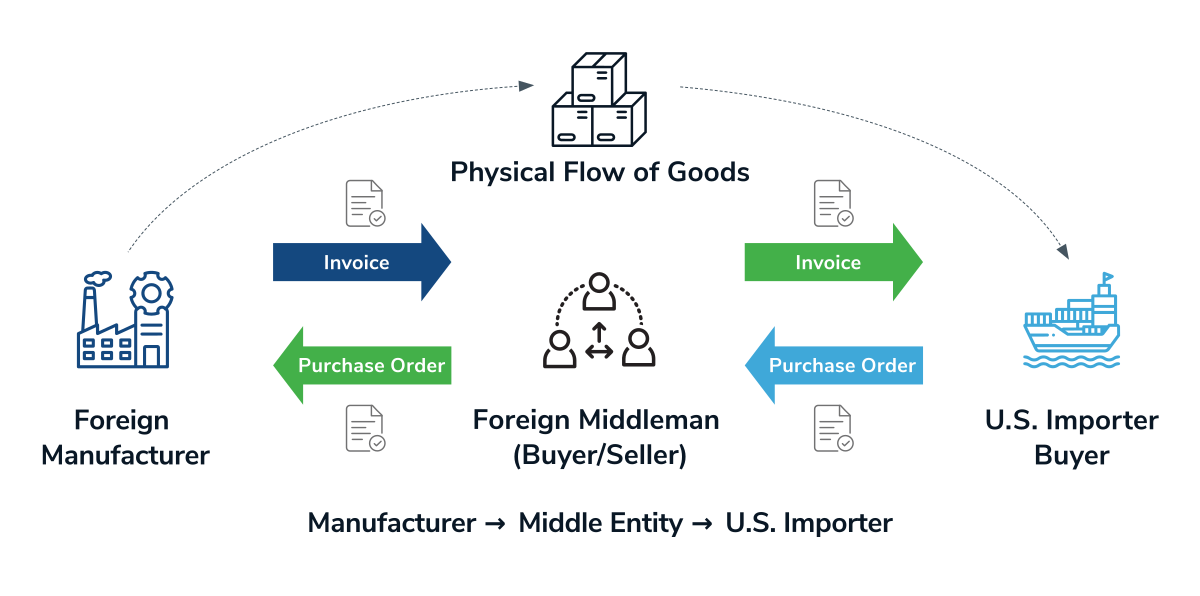


First Sale for Export is a customs valuation strategy that allows importers in multi-tier supply chains to reduce duty costs by declaring an earlier qualifying sale price, often the manufacturer-to-middle-entity price, instead of the higher, marked-up resale price to the U.S. importer. This approach is based on the U.S. transaction value statute and has been developed through case law and Customs and Border Protection (CBP) guidance.
For companies with multi-tier supply chains, the impact can be significant. Declaring a lower customs value directly reduces the duties paid on recurring U.S. imports, often creating a meaningful profit-and-loss (P&L) benefit. In the right fact pattern, the return on investment (ROI) can be compelling; we have seen First Sale opportunities where estimated annual savings were 20, 40 or more times the expected implementation cost.
U.S. importers are operating in a higher-tariff environment, with many companies facing total duty rates in the 15% to 25% range depending on product, country of origin and applicable tariff measures. As a result, customs value is no longer just a compliance input; it is a direct P&L lever, and every quarter without action means continuing to pay duty on a higher value than may be required.
Without First Sale, the importer usually declares the higher, marked-up resale price from invoice 2 as the customs value.
With First Sale, the importer may be able to declare the lower manufacturer price from invoice 1, resulting in a reduced customs value and lower duty:
Scenario | Declared Customs Value | Duty Rate | Duty Paid |
|---|---|---|---|
Without First Sale: using marked-up resale price | $2,500K | 20% | $500K |
With First Sale: using manufacturer price | $1,500K | 20% | $300K |
Potential duty savings | $200K |
At scale, the opportunity can be substantial. For example, if annual imports declared using the second-sale price of $50 million, and the first-sale price was $30 million (40% lower), applying a 20% duty rate to the difference would produce an annual duty savings of $4 million.
A First Sale review may be worth considering if you can answer “yes” to these questions:
Many companies with mature or strategic global trade functions have already implemented or are actively pursuing First Sale as part of their duty mitigation strategy. A short review can quickly estimate potential savings, compare them to the expected implementation effort and determine whether the ROI makes it worth moving forward.
The first step does not need to be a full implementation project. An initial review typically focuses on three questions:
*First Sale generally requires a bona fide sale, goods clearly destined for the United States and arm’s-length pricing consistent with Nissho Iwai and CBP guidance under 19 U.S.C. § 1401a(b)(1).
First Sale sits at the intersection of transfer pricing, customs valuation and supply chain structure. Most firms approach this process from only one side, usually either from transfer pricing or customs. The resulting gap can create risk, particularly where the valuation position is not aligned with how transactions are structured or documented.
Kroll integrates both perspectives. We evaluate the pricing model alongside the customs valuation framework to ensure the approach is both beneficial and supportable.
That combination matters, especially as customs authorities increasingly scrutinize valuation positions tied to intercompany and multi-tier supply chains.
For companies with U.S. imports and multi-tier supply chains, First Sale for Export can be one of the most practical and impactful ways to reduce recurring customs duty costs. In the current tariff environment, the question is not whether to explore it but how quickly you can act.
Stay Ahead with Kroll
Transfer Pricing
Kroll's team of internationally recognized transfer pricing advisors provide the technical expertise and industry experience necessary to ensure understandable, implementable and supportable results.
Trade and Customs
Kroll helps clients proactively develop strategies, manage risks, uncover and address compliance gaps, and respond to investigations or enforcement actions across the full spectrum of trade and customs challenges.


