
Kroll Geoeconomic Navigator

Kroll Geoeconomic Risk Index

Translating Global Uncertainty into Decision-Ready Insights

Global events are reshaping markets, supply chains, financing conditions and investment decisions.

The Kroll Geoeconomic Risk Index is a proprietary measure of global economic pressure. It helps organizations monitor how geopolitical and economic developments are evolving and identify where emerging pressures may warrant closer attention.

The Index combines 33 indicators across six risk pillars:

  • Conflict and Security Pressure
  • Trade Connectivity
  • Commodity and Energy Pressure
  • Financial Conditions
  • Strategic Alignment
  • Market Attention

Drawing on a range of public and licensed data sources, the Index provides a structured view of the forces shaping global business conditions.

The Kroll Geoeconomic Resilience Outlook interprets changes in the Index and examines the potential implications for businesses and investors.

For organizations requiring deeper analysis, Kroll's Geoeconomic Resilience Intelligence Platform (GRIP) helps assess exposure, test assumptions and support decision-making.
Latest Outlook: Elevated Pressures Persist as Market Volatility Rises

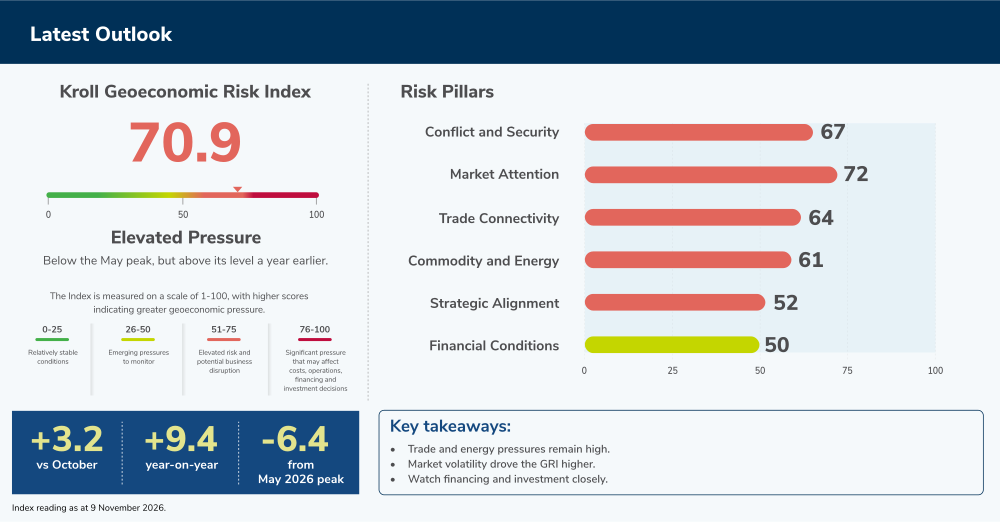
As of November 9, 2026, the Kroll Geoeconomic Risk Index stood at 70.9, up 3.2 points from October. Heightened market-implied risk following the U.S. midterm elections added to persistent energy pressure, pushing the Index higher.

Geopolitical, trade, commodity and energy pressures remain elevated, while broader financial conditions have so far been less affected.

The key question is whether higher energy and financing costs begin to affect cash flow, financing conditions, investment decisions and project delivery in the months ahead.

Kroll Geoeconomic Risk Index

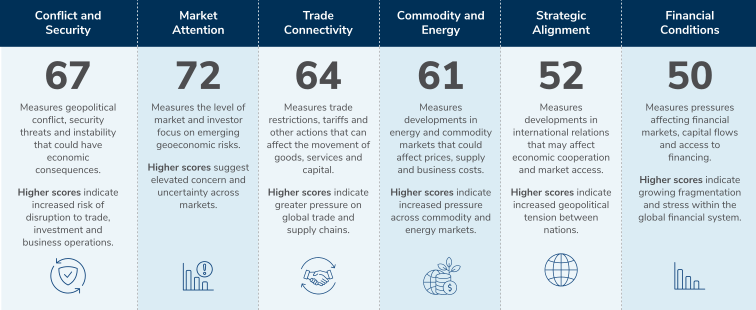
The Index is made up of several components, including trade, commodities, diplomacy and financial conditions. Changes within these areas help explain the trends affecting global markets and business conditions.

Understanding The Risk Pillars

Kroll Geoeconomic Risk Index

What Should Your Organization Test?


The same external shock can affect organizations in very different ways.

Factors such as supply chain dependencies, customer markets, financing requirements and the ability to manage rising costs can all influence the impact.

The following questions can help organizations assess whether their plans remain resilient if current pressures persist.

Operating Resilience

Which suppliers, routes, inputs and contracts assume that disruption or cost pressures will ease quickly, and how long could higher costs be absorbed if they persist?

Financing and Valuation

Would cash flow, liquidity and refinancing plans remain viable if inflation or financing costs remained elevated?

Investment and Strategy

Which investment cases depend on timely capacity delivery, lower interest rates or rapid productivity gains?
Cyber Risk

Get the Analysis Behind the Numbers

Get the latest insights and analysis on global developments shaping markets, investment and business decisions delivered straight to your inbox.

Subscribe to Kroll's Geoeconomic Resilience Outlook for:

  • Key Index findings and changes in global geoeconomic pressure
  • Kroll's assessment of potential business implications
  • Practical questions to support reviews of operating, financing and investment assumptions

How Organizations Use the Index

Supply Chain Resilience

Assess exposure to trade disruption and supplier dependencies.

Cost and Margin Planning

Monitor how commodity and market pressures could affect profitability.

Financing Decisions

Evaluate financing assumptions as conditions change.

Investment Strategy

Stress-test business and investment plans under different scenarios.

Geoeconomic Information Tailored for Your Needs

  • The Index measures global pressure
    It brings together indicators across six risk pillars to provide a headline measure of geoeconomic conditions.
  • The Outlook explains the findings, direct to your Inbox
    It examines changes in the Index and potential implications for business and investment decisions.
  • The platform supports tailored analysis
    GRIP combines external intelligence with proprietary data, analytics, modelling and economic expertise to provide analysis tailored to your business.

If you'd like to learn more about Kroll's GRIP, complete the form and a member of the team will be in touch.

See What the Latest Index Findings Could Mean for You

If you'd like to learn more about the Index, Outlook or GRIP, complete the form and a member of the team will be in touch.

Get In Touch

Frequently Asked Questions

The Kroll Geoeconomic Risk Index and Geoeconomic Resilience Outlook help organizations understand how global developments could affect their business, investments and operations.

Drawing on data across trade, commodities, conflict, financial markets and diplomacy, they highlight where pressure is building and what it could mean for businesses and investors.

Updated regularly, they help organizations distinguish between short-term disruption and longer-term structural trends.

Important Information

The indicators presented in the Kroll Geoeconomic Risk Index are based on publicly available and licensed data sources analyzed using Kroll's proprietary methodologies and AI- and automation-assisted analytical processes.

The Index is updated regularly and should not be considered a source of real-time information. Historical information and underlying data may be revised as new information becomes available.

Legal Disclaimer

The content on this webpage, any email newsletters you may subscribe to on this webpage, the Kroll Geoeconomic Risk Index and any information produced by it (the "Content") is provided solely for general informational purposes and does not address the circumstances of any particular individual or entity. By making the Content available, Kroll is not providing economic, legal, accounting, tax or other professional advice or services, and nothing contained herein should be construed as such.

The Content is not a substitute for consultation with appropriately qualified professional advisers. No reader should act or refrain from acting on the basis of any information contained in the Content without obtaining specific professional advice relevant to their particular circumstances. No reliance should be placed on the Content or the information contained herein.

Kroll may have used artificial intelligence tools in the preparation of the Content. Although Kroll endeavors to provide accurate and timely information, it makes no representation, warranty or guarantee, express or implied, as to the accuracy, completeness, timeliness or continued accuracy of any information contained in the Content.

To the fullest extent permitted by applicable law, Kroll assumes no duty of care to any reader and accepts no responsibility or liability for any loss, damage or other consequence arising directly or indirectly from the use of, or reliance on, the Content or any information contained herein.

Stay Ahead with Kroll

Kroll Economics

Turning volatility into clarity—with strategic, data-driven insight you can trust.

Competition and Regulatory Economics

Leading economic expertise for competition, regulatory and disputes matters

Valuation Services

When companies require an objective and independent assessment of value, they look to Kroll.

Transaction Advisory Services

Kroll provides comprehensive due diligence, operational insights, and tax structuring support, assisting private equity firms and corporate clients throughout the deal lifecycle.

Investigations, Diligence and Compliance

Kroll’s Investigations, Diligence and Compliance team helps our clients stay ahead of complex demands related to independent expert analysis, testimony, advice and intelligence in complex investigations, litigation and projects globally.