

On September 28, 2026, the second phase of the UK EMIR reconciliation requirements came into effect, marking a significant expansion of the data that Trade Repositories (TRs) are required to reconcile between counterparties.
The change was always built into the UK EMIR Refit framework. When the revised UK reporting regime went live on September 30, 2024, reconciliation applied to an initial subset of reportable fields, while a further group of fields was deferred for approximately two years. The FCA and the Bank of England subsequently confirmed September 28, 2026, as the effective date for these additional reconciliation requirements.
Key Changes to the Reconciliation Framework
The most important change is the significant expansion of the reconciliation perimeter. Data that was reportable under UK EMIR Refit but was not initially subject to counterparty reconciliation must now be compared between the two sides of the derivative.
The additional scope covers areas including transaction identifiers and links, instrument underlying and basket information, settlement currencies, valuation data, price and notional schedules, payment information, interest rate spreads, exchange rates and asset-class-specific information.
Of particular importance is the increased focus on valuation data, including valuation amount, currency, method and, where applicable, delta. This means inconsistencies between counterparties in these areas are now more visible through the reconciliation process.
The FCA has also removed the Name of the Underlying Index field (Table 2, Item 16) from the reconciliation requirements.
What Does This Mean for Firms?
For firms with UK EMIR reporting obligations, Phase 2 is primarily a data quality and controls challenge.
A report being successfully accepted by a TR does not necessarily mean that the data reported by both counterparties is consistent. With substantially more fields now being compared, firms may see increased reconciliation breaks caused by differences in reference data, product classification, lifecycle processing, economic terms or valuations.
Firms should therefore ensure they have effective processes to receive, investigate and remediate reconciliation breaks, with clear ownership and escalation procedures. This is particularly important where reporting is delegated, as firms should ensure their oversight arrangements provide sufficient visibility into reconciliation results and remediation efforts.
UK vs EU EMIR – Timeline
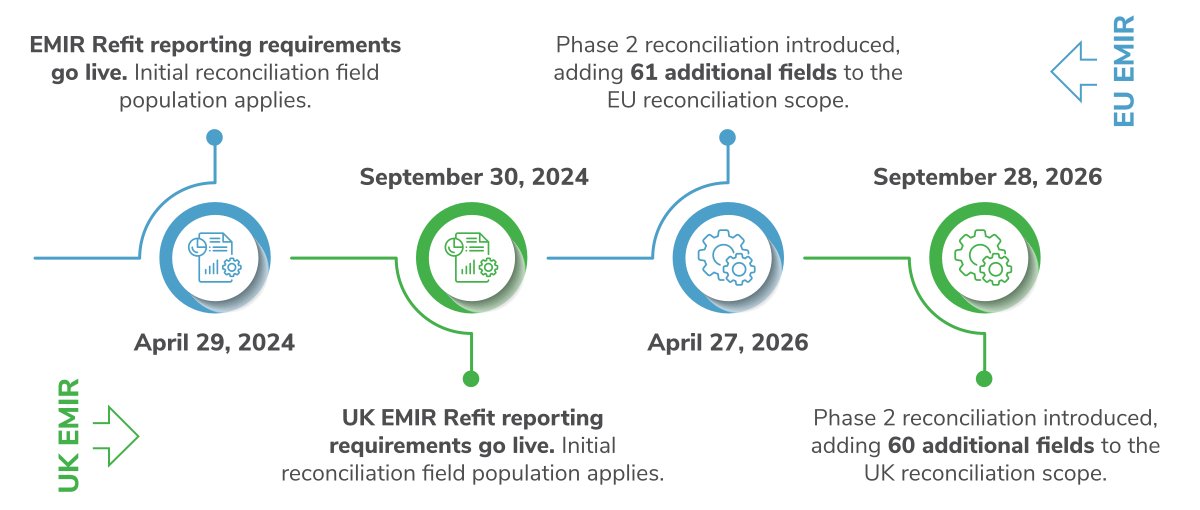
The two regimes remain closely aligned, reflecting their common starting point and the international drive toward more consistent derivatives data. However, they are not identical, meaning firms subject to both regimes should avoid assuming that a single reconciliation configuration will necessarily satisfy both sets of requirements.
For UK reporting firms, the September changes represent an important shift: Reconciliation is increasingly becoming a continuous test of the quality and consistency of the underlying reporting data, rather than simply a downstream reporting control.

