
Rapid growth of AI is changing more than the computing equipment housed inside data centers, altering the physical infrastructure required to support the equipment and, by extension, property tax valuation.
At the center of this evolution is heat. Successive generations of graphics processing units (GPUs) are delivering dramatically more computing power, but they are also concentrating more electrical load within individual racks, a phenomenon known as rack density.
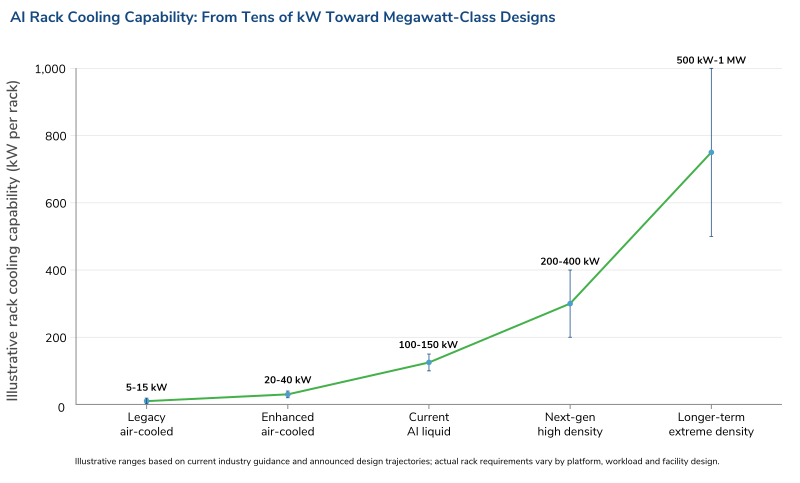
At one point, traditional enterprise and cloud racks operated in the 5 to 20 kilowatt (kW) range. Current AI deployments can exceed 100 kW per rack, and industry road maps now contemplate 200 to 400 kW racks, 500 kW systems and, eventually, megawatt (MW)-class rack designs. For perspective, 1 MW would power an average of 800 U.S. households, all in a space the size of a refrigerator.
Rack density gives rise to heat density. The First Law of Thermodynamics tells us that each watt of power used by an AI server converts to heat, and that heat must be offset by an equal amount of cooling, or facilities risk melting down the very servers that generate that heat.
For property tax professionals, the important question is not simply how much these cooling systems cost, but what the technological transition says about the economic utility, remaining life, and contributory value of both new and existing data centers.