

Australia’s east coast gas market continues to be the focus of policy debate, often framed around concerns of structural supply shortages. The Commonwealth Government has proposed a standing export-linked domestic supply obligation, supported by a draft design framework currently under consultation.
A comprehensive review of current market data and forecasting trends indicates that the system remains broadly balanced at an annual level.
Rather than a widespread supply deficit, the market faces a targeted and time-bound challenge: ensuring reliable gas deliverability during peak winter periods in the southern states.
This distinction is critical in shaping effective, proportionate policy responses.
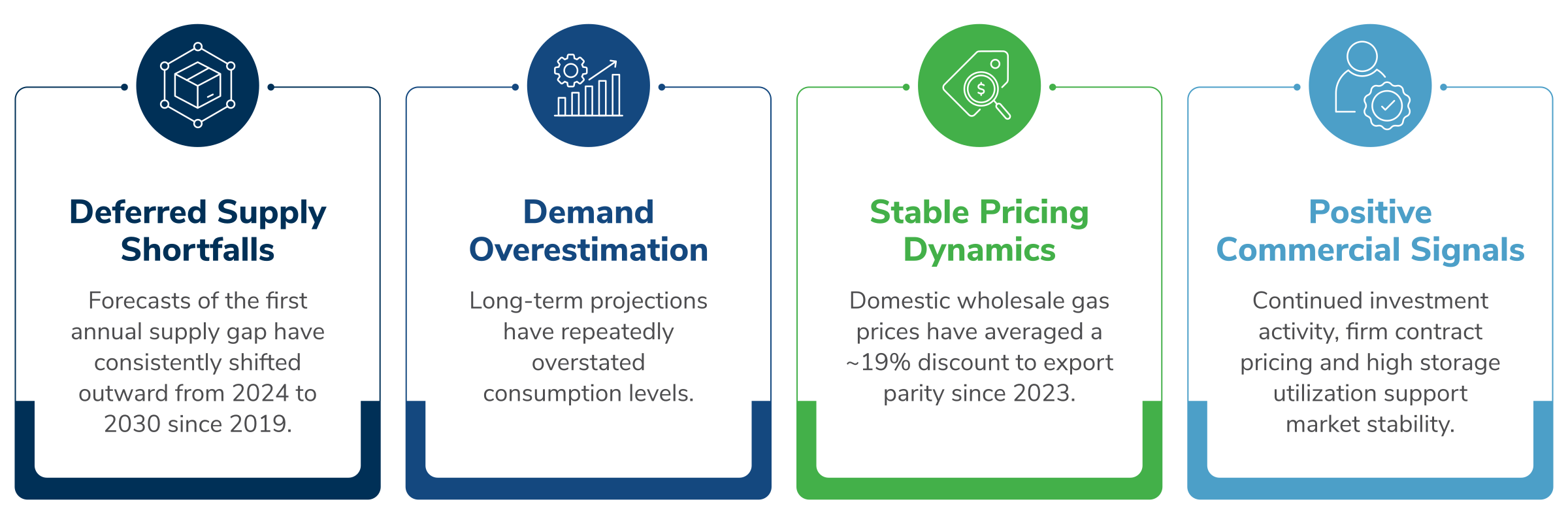
Together, these indicators confirm that market fundamentals remain robust, with no immediate structural imbalance.
The Key Risk: Southern System Deliverability
The primary risk is not one of total supply, but of peak-day deliverability in the southern system.
This risk is driven by:
- Declining production from legacy gas fields
- Pipeline and transportation constraints
- Limited storage capacity during periods of peak demand
Importantly, this is a localized, operational issue rather than a system-wide volume shortage. As such, it requires targeted interventions rather than broad, structural policy measures.
Limitations of Reservation-Based Policies
Gas reservation mechanisms have been proposed as a means of improving domestic supply availability. The Government’s draft design framework incorporates a range of flexibility mechanisms, including variation of obligations, treatment of existing contracts, and provisions to account for infrastructure constraints and surplus supply.
These features improve overall workability. However, they do not fully resolve the underlying calibration issue, particularly given the obligation remains anchored to annual volume rather than the timing, location and deliverability characteristics of supply.
Key considerations include:
- Policy Misalignment: Reservation schemes operate on annual volumes, while the underlying issue relates to short-term, location-specific deliverability
- Economic Trade-offs: Lower domestic prices achieved through reservation represent a transfer from producers rather than a net economic gain
- Supply Displacement Risk: Reservation requirements can disincentivize investment in southern production, which is critical for peak-day reliability
Analysis indicates that higher reservation levels could result in:
- Significant displacement of southern gas production
- Increased dependence on new pipeline and transport infrastructure
- Total annual welfare costs range from $1.5 billion (15%) to $2.9 (20%)
In effect, such measures risk exacerbating the very constraints they are intended to address if not carefully calibrated to underlying market conditions.
Supporting a Proportionate Policy Response
Evidence from recent years demonstrates that near-term market outlooks are reliable, while long-term projections are inherently uncertain and subject to revision.
- Short-term forecasts (2–3 years) have proven accurate and actionable
- Longer-term projections have consistently overstated risks and deferred expected shortfalls
This reinforces the importance of adopting a flexible, evidence-led policy approach, rather than implementing permanent measures based on uncertain long-term assumptions.
A Targeted Framework for Market Resilience
A structured, proportionate policy architecture offers a more effective pathway to managing system adequacy while preserving market efficiency.
Enhanced Market Intelligence | Gas Market Impact Assessment | Graduated Adequacy Response |
|---|---|---|
|
|
|
This framework ensures that policy intervention remains responsive, targeted and proportionate.
Conclusion
The east coast gas market is not facing a broad structural shortage. Instead, it is navigating a specific and manageable operational challenge within the southern system.
Addressing this challenge effectively requires:
- Precision rather than blanket interventions
- Evidence-based decision-making
- Flexible policy mechanisms that evolve with market conditions
A standing export-linked domestic supply obligation is a high-impact policy instrument. There is a clear rationale for maintaining such a tool within the policy framework.
The key design question is how and when it is applied.
A more effective approach is to embed this mechanism within a structured, evidence-led and graduated policy architecture, where intervention is linked to observable system conditions and escalates only where necessary.
By adopting a proportionate and targeted approach, policymakers can enhance system reliability while maintaining the integrity and efficiency of the broader gas market.

Stay Ahead with Kroll
Kroll Economics
Turning volatility into clarity—with strategic, data-driven insight you can trust.