

Financial Advisory
March 13, 2026
Exiting Without Value Leakage: Strategic Contingency Models for Solvent Wind-Downs
Solvent wind-down planning has evolved from a niche regulatory expectation into a core element of strategic management for banks and investment firms. Even well-capitalized and profitable institutions must be capable of discontinuing a business line, exiting a market, or winding down operations in an orderly and solvent manner without undermining financial stability, franchise value, client relationships, or long-term profitability. In an environment characterized by heightened regulatory scrutiny, evolving business models, and increasing geopolitical fragmentation, wind-down capabilities are no longer relevant only in times of distress. They are a strategic discipline that supports decision-making and sustainable value creation.
In this context, value leakage refers to avoidable erosion of franchise value and economics during an exit, predominantly through forced sales and haircuts, increased funding spreads, heightened client churn, execution delays, operational friction, and stranded or underestimated costs.
Historically, exit planning has often been treated as an afterthought: triggered late, driven by pressure, and executed reactively. By contrast, a well-designed solvent wind-down framework established ahead of need allows institutions to exit activities in a controlled manner, on their own terms and pace, and with a clear understanding of financial and operational consequences. Increasingly, supervisors expect institutions to demonstrate precisely this capability.
Translating strategic intent into an executable wind-down capability depends heavily on robust contingency models. These models form the analytical backbone of solvent wind-down planning. They quantify the financial, capital, liquidity, and funding implications of an orderly exit over time, allowing institutions to anticipate constraints, identify critical dependencies, and maintain control throughout execution. Rather than relying on static balance sheet snapshots or high-level assumptions, contingency models provide a dynamic, forward-looking view of how a wind-down would unfold across multiple dimensions.
When designed effectively, contingency models enable senior management and boards to assess whether a proposed exit is feasible, sustainable, and value-preserving under a range of plausible scenarios. They support informed trade-offs between speed, cost, and risk, and help ensure that customer protection, market integrity, and regulatory expectations remain central throughout the process. In doing so, they transform solvent wind-down planning from a compliance or regulatory exercise into a strategic management tool.
The message for senior management and boards is clear: Solvent wind-down planning is not about anticipating failure. It is about demonstrating preparedness, operational discipline, and strategic optionality. Institutions that invest early in credible solvent wind-down capabilities strengthen supervisory confidence, enhance resilience to strategic shocks, and improve their ability to navigate an increasingly dynamic and uncertain market landscape, without unnecessary value leakage.
Core Elements of an Effective Contingency Model
In practice, many wind-down models “start life” as spreadsheets built to prove feasibility at a point in time. Under real execution conditions such as market volatility, behavioral responses from clients and counterparties, and operational bottlenecks, those models often fail to provide the clarity needed for timely decisions. A decision-grade contingency model is different as it links granular run-off and transfer mechanics to capital, liquidity, and cost outcomes over time, and it embeds management actions and triggers. That is how a wind-down remains orderly, controlled, and value-preserving.
The figure below summarizes a decision-grade contingency model architecture. The key point is the feedback loop: scenarios and management actions are iterated against quantified constraints.
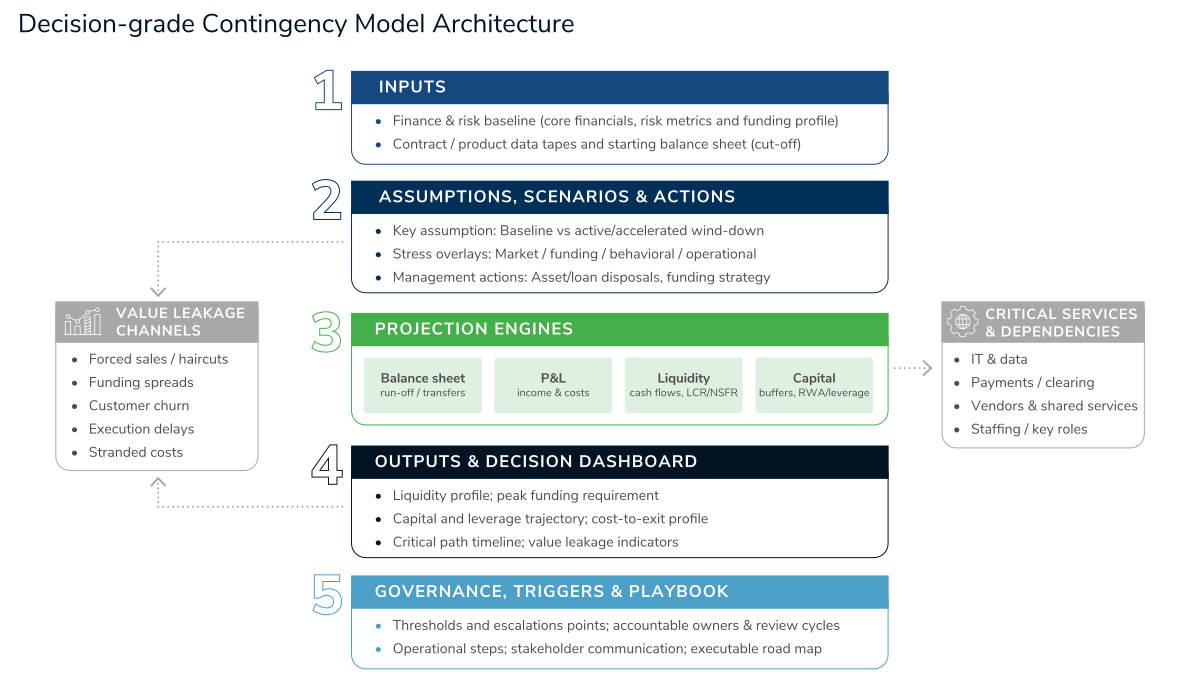
Figure: Decision-grade contingency model architecture (illustrative and simplified)
A contingency model provides a quantified view of how capital, liquidity, funding, profitability, and operational capacity evolve as activities are reduced, transferred, or exited. Done well, it does not simply forecast outcomes, it translates strategy into constraints, decision points and management actions that prevent avoidable value leakage.
How Can Kroll Help?
Many of the weaknesses that undermine solvent wind-down readiness are not caused by a lack of intent, but by gaps in quantification, operational mapping, and governance. The good news is that these gaps are addressable. A decision-grade solvent wind-down capability can be built by combining robust modeling with execution pragmatism, and by embedding both within a clear governance and reporting framework.
Kroll is the leading independent provider of financial and risk advisory solutions, helping clients stay ahead of complex demands through trusted expertise, data, and technology. Kroll can support institutions in translating solvent wind-down ambitions into an actionable and supervisor-credible capability, helping boards and senior management move from a high-level plan to a decision that is demonstrably executable. Our experts support the development of decision-grade contingency models and scenario analysis that clarify the wind-down funding and liquidity horizon, key constraints, and the actions required to preserve value as conditions change.
Just as importantly, we help to ensure the wind-down is operationally feasible. That includes translating dependencies and execution requirements into a clear governance and reporting approach, and, where relevant, supporting the execution of portfolio disposals such as asset or loan sales as part of the exit strategy.

Stay Ahead with Kroll
Transaction Advisory Services
Kroll provides comprehensive due diligence, operational insights, and tax structuring support, assisting private equity firms and corporate clients throughout the deal lifecycle.
Operational Advisory Services
Operational Advisory Services increases company performance in transaction, turnaround, and transformation situations.
Valuation Services
When companies require an objective and independent assessment of value, they look to Kroll.