
Has your organization been exposed? How can you act on the exposures that matter most? What’s the best way to demonstrate measurable risk reduction?

Cyber
Kroll Perspectives: AI-Accelerated Cyber Risk Management
Six Shifts Driven by Frontier AI
In our conversations with clients since the Project Glasswing and Project QuiltWorks announcements, the question has moved from “What does this mean?” to “How do we operationalize our response?”
AI accelerates the clock while reinforcing the fundamentals
Security leaders still need inventory, ownership, prioritization, remediation and verification; those capabilities must now operate on compressed timelines.
Discovery is becoming abundant
Remediation velocity is becoming the scarce resource. The ability to prioritize what matters, assign owners, remediate and demonstrate risk reduction will define true resilience.
Threat Exposure Management is shifting from a security workflow to an enterprise risk discipline
CISOs, CFOs, general counsel, CROs and boards need a shared view of exposure, financial impact, legal posture, ownership and evidence.
Regulators are emphasizing evidence and accountability
The expectations center on governance, resilience, disclosure readiness, third-party oversight, documentation and defensible decisions.
The focus for security teams is shrinking the exposure window
Prioritize the paths that can affect the business and reduce those exposures before attackers can operationalize them.
CrowdStrike's Project QuiltWorks, with Kroll among its initial partners, was built for the next step
We help close the exposure gap at machine speed by enabling organizations to assess, prioritize and remediate AI-discovered vulnerabilities in production code.
27 sec
Fastest adversary breakout time
89%
Year-over-year rise in AI-powered attacks
0 sec
Time between discovery and exploit
Source: CrowdStrike 2026 Global Threat Report
How to Prepare
Frontier AI Risk Assessment
Kroll delivers frontier AI risk assessments that help organizations move from awareness to action through one continuous exposure-closure loop. We enable leaders to determine not only where they are exposed, but also which risks to prioritize, what actions are required, who owns them, and how to fund and verify remediation, accelerating remediation velocity.
We Help Clients
- Assess exposure across the organization and validate how individual weaknesses can combine to create real attack paths.
- Prioritize exposure using threat intelligence, attack paths, privilege impact and business context.
- Operationalize remediation through workflows, SLAs, escalation paths and orchestration.
- Validate closure of attack paths and continuously adapt as threats and environments evolve.
Our Clients Achieve
- Faster discovery and prioritization
- Remediation within defined SLAs
- Reduced attack paths
- Improved patching cadence
- Clear, executive-ready reporting
Project QuiltWorks
Project QuiltWorks is an industry coalition including Kroll, built to close the AI vulnerability gap for enterprises. This coalition sets a new standard for vulnerability discovery and collaborative cybersecurity in AI.
Frontier AI models integrated across the Falcon platform through Project QuiltWorks uncover logic flaws, misconfigurations and novel exploit paths that scanners and human reviews may miss.
As part of Project QuiltWorks, Kroll is working with CrowdStrike to combine technology-enabled discovery, adversary-informed prioritization and guided remediation with Kroll’s expertise in consulting, incident response, regulatory compliance, AI risk management and remediation.
What Every C-Suite Should Be Asking
C-Suite Role | Key Considerations | Key Threats to Manage and Measure |
|---|---|---|
CISO | Which exposures can an attacker realistically reach, chain and exploit? Where does remediation stall? | Threat-informed prioritization, ownership, mitigation plans, verification evidence and operational metrics. |
CFO | What is the potential financial impact, which investments reduce risk most and where are we paying for activity rather than risk reduction? | Financial exposure scenarios, remediation capacity analysis, risk-reduction options and investment trade-offs. |
General Counsel / CRO | What is material, what needs disclosure or notification, who accepted the risk and what evidence supports the decision? | Governance and risk management records, disclosure and notification playbooks, third-party obligations and defensible documentation. |
Board / Audit or Risk Committee | Are we exposed in ways that affect operations, customers, regulated data, revenue or resilience? | Plain-language reporting on exposure trends, verified closure, accepted risks, residual exposure and investment decisions. |
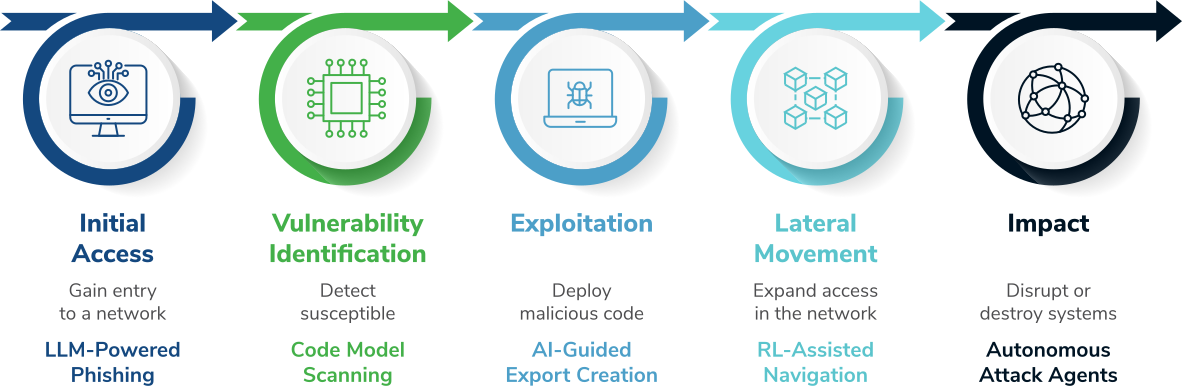
AI-Enhanced Vulnerability Exploitation Pathway
What Executives Can Do Now
Immediate Actions
- Align security, legal, finance, risk and business leaders on how exposure decisions will be made and escalated.
- Establish a shared view of critical exposures, accountable owners and business impact.
- Review how AI-enabled systems, agents, third parties and non-human identities are incorporated into existing risk management processes.
- Connect exposure management with incident response, crisis management and disclosure planning.
- Identify where remediation, mitigation or risk acceptance decisions are slowing down.
Near-Term Actions
- Evolve prioritization to include exploitability, attack paths, business impact, resilience impact and mitigation options.
- Strengthen the operating model for exposure management, including ownership, escalation, governance and executive reporting.
- Test how quickly the organization can respond to a high-impact exposure across security, IT, legal, finance and the business.
- Refresh incident response, BCP and DR planning for AI-enabled systems, third-party dependencies and accelerated exploitation scenarios.
- Develop board-level reporting that shows exposure reduction, decision quality, accepted risk and remediation capacity.








Stay Ahead With Kroll
Kroll supports thousands of clients on the frontier of AI and risk, leveraging global, market-leading expertise in a wide range of risk mitigation disciplines. Learn more about the core areas of expertise that we leverage to build our bespoke solutions.
Why Choose Kroll?
- Deep technical and vulnerability management expertise, gained from more than 150k hours of security testing per year
- Unparalleled incident response experience
- Frontline intelligence from thousands of investigations every year
- A broad range of services for security, risk, investigations and compliance


Stay Ahead with Kroll
Cyber Risk Assessments
Kroll's cyber risk assessments and advisory services deliver actionable recommendations to improve security, using industry best practices & the best technology available.
Threat Exposure Management
Kroll’s field-proven cyber security assessment and testing solutions help identify, evaluate and prioritize risks to people, data, operations and technologies worldwide.
Technology Expert Services
Our team has decades of experience serving as independent advisors, and our client-focused approach and deep technical expertise allows us to work across a spectrum of technologies, industries and data issues.
Cyber Transformation
Implement, configure and run scalable cybersecurity programs at the pace of digital transformation
Regulatory Compliance Assessments
Expert support to comply with a wide range of cybersecurity compliance requirements and build long-term cyber resilience.
Cyber Litigation Support
Whether responding to an investigatory matter, forensic discovery demand, or information security incident, Kroll’s forensic engineers have extensive experience providing litigation support and global eDiscovery services to help clients win cases and mitigate losses.