Private Credit’s PIK Pullback: Data and Discipline | Kroll

Private Asset Valuation Solutions

October 29, 2026

Private Credit’s PIK Pullback: Data and Discipline

New first lien private credit loans are roughly half as likely as outstanding loans to feature terms that include payment-in-kind (PIK) interest, according to the Kroll StepStone Private Credit Benchmarks’ U.S. and European First Lien Credit benchmarks.

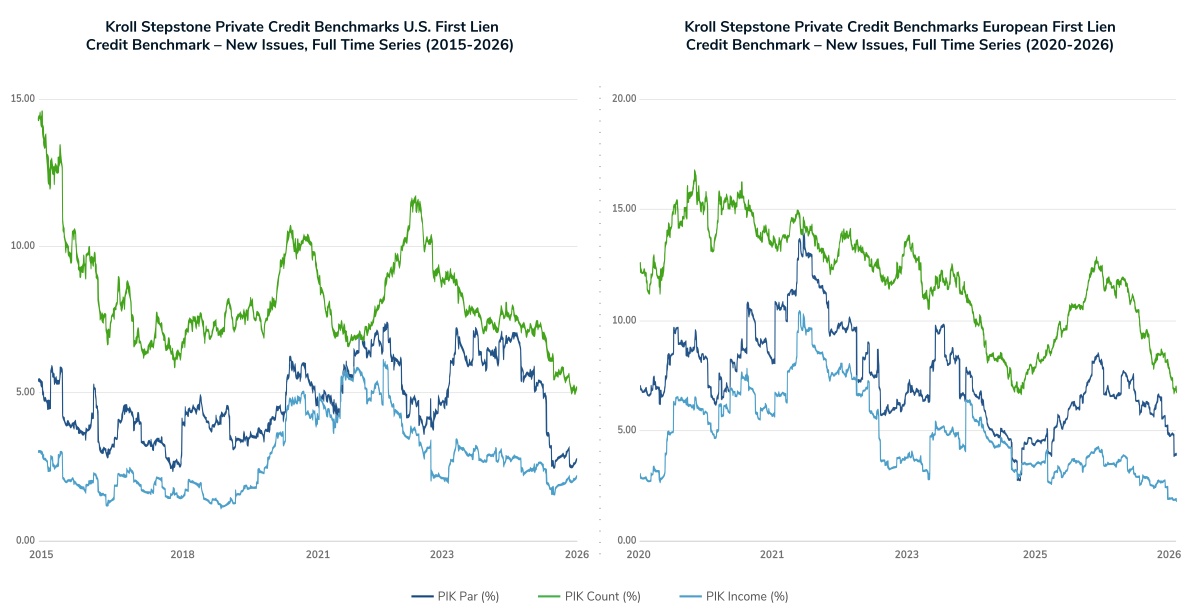
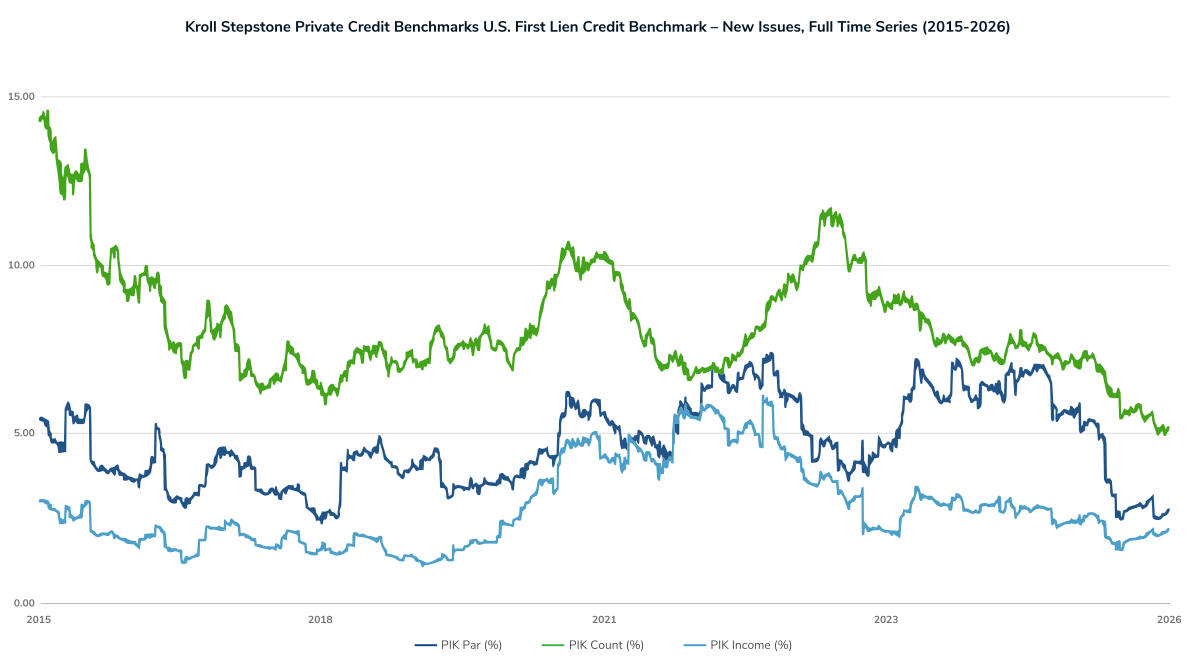
As of October 27, 2026, PIK-bearing loans accounted for 5.2% of U.S. and 6.7% of European new issues on a 12-month lookback, compared with approximately 9.5% and 13.7%, respectively, on the Outstanding Issues Monitor’s trailing 12-month measure. These differences provide additional context for concerns raised in recent media coverage regarding credit quality, borrower liquidity and the sustainability of debt servicing.

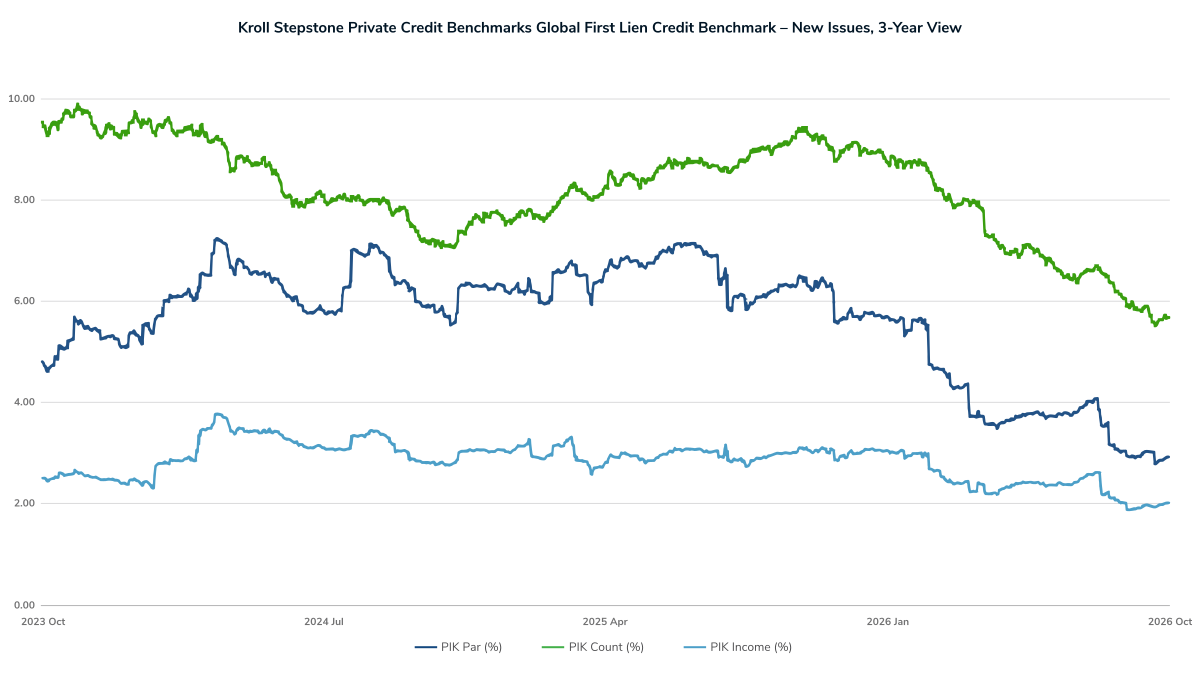
At the end of Q2 2026, PIK represented 4.7% of interest income on outstanding loans in the Kroll StepStone Private Credit Benchmarks’ Global First Lien benchmark. By comparison, the same benchmark’s new issues showed PIK at just 2.0% of interest income using a 12-month origination lookback, as of October 27. The decline in PIK usage in the new issue market could reflect increased caution undertaken by lenders and borrowers amid geopolitical uncertainty and AI disruption fears.
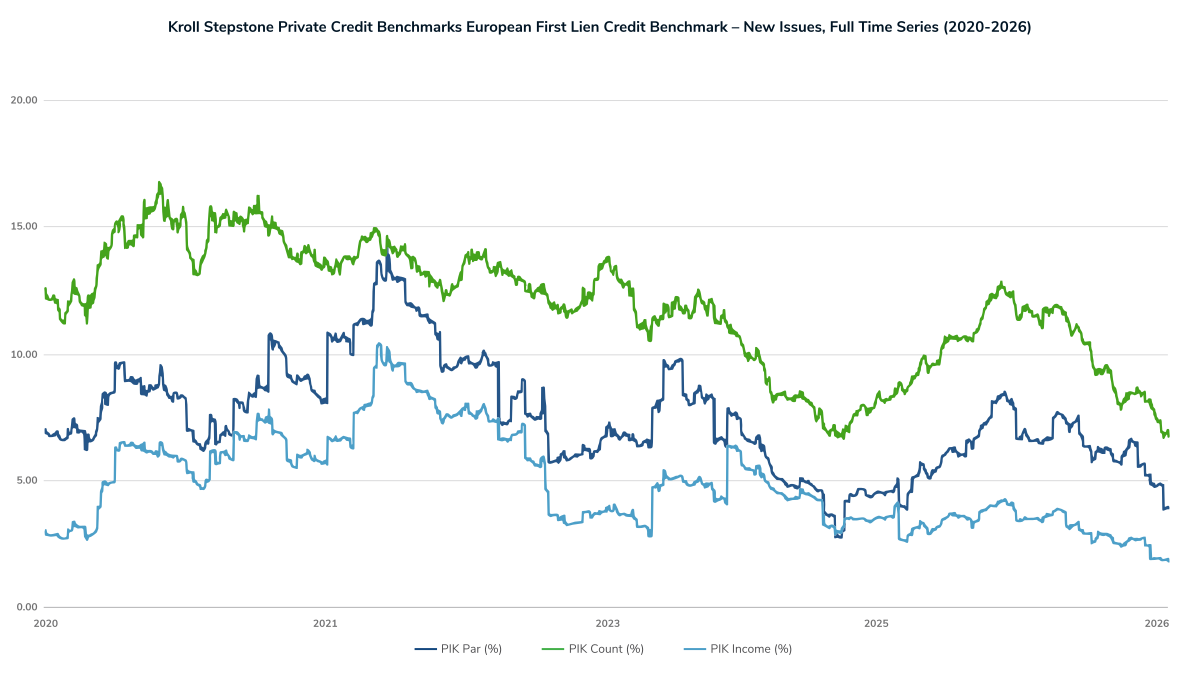
U.S. and European First Lien Credit benchmarks show even lower PIK prevalence over shorter origination lookbacks. Using 180- and 90-day lookbacks as of October 27, 2.9% and 1.3% of U.S. new issues bore PIK, respectively, compared with 5.6% and 4.6% in Europe. Recent readings should not yet be treated as evidence of a sustained trend.

Historical new issue data further magnifies the PIK decline. On the Global First Lien benchmark’s 12-month origination lookback as of October 27, PIK’s share of interest income had fallen to a seven-year low. PIK-bearing loans accounted for 2.9% of new-issue par value, the lowest value since January 2017. On the 365-day lookback as of October 27, U.S. First Lien Credit PIK prevalence was the lowest since the series began in 2015; European First Lien Credit was near its series low.
Regional Breakdown

The U.S. and European First Lien Credit benchmarks also show differences in PIK’s contribution to interest income. As of October 27, PIK represented 2.2% of U.S. and 1.8% of European interest income using a 365-day origination lookback. This discrepancy illustrates that while PIK features are more prevalent in European new deals, they contribute proportionately less to total interest income than in the U.S.

Outstanding loans in these first lien benchmarks show a different pattern. On the Outstanding Issues Monitor’s trailing 12-month measure, PIK accounted for approximately 7.2% of European and 3.9% of U.S. interest income, with the European figure four times the 1.8% on new European issues using the 365-day lookback. On the same trailing 12-month measure, PIK-bearing European loans’ share of outstanding par rose from about 10.0% a year ago to 10.8%. Lower PIK frequency at origination therefore coexists with continued exposure in existing portfolios.

The UK also features a large discrepancy between PIK presence and interest income. In the Kroll StepStone Private Credit Benchmarks’ UK new-issue data, using a 12-month origination lookback as of October 25, PIK was present in 6.7% of loans, representing 2.1% of par, but accounted for just 0.8% of interest income. The contrast between the three geographies underscores the limitations of examining exposure only through the percentage of loans with a PIK component.


PIK Usage Shifts

While PIK provisions are frequently associated with risk-taking activity, liquidity relief is particularly valuable for capital-intensive, earlier-stage businesses.

Regardless of region, PIK options are commonly negotiated into loan terms prior to issuance. Often, borrowers are given a cash or PIK toggle that allows them to choose whether to pay interest in cash or defer payment. As PIK may be used to preserve cash for reinvestment, lower usage is relevant to assessing borrower and lender discipline.

Underneath the numbers, not all PIK components represent the same level of risk.


Risk Context

Distressed situations are more likely to arise when borrowers ask to change interest to PIK from cash in the middle of a loan term.

These changes may signal an anticipated failure to adhere to previously set loan terms, either from an inability to pay cash owed or a business need to preserve cash. That differs from exercising a PIK option negotiated at origination.

This distinction is key when evaluating whether a loan’s PIK component is cause for scrutiny. The flexibility of PIK, when negotiated into original loan terms, can serve positively for both parties.


The Importance of Data

The Kroll StepStone Private Credit Benchmarks now provide insights into the prevalence of PIK-bearing loans across new and outstanding issues, providing data on loan count, income percentage and percentage of par. Ultimately, this data can help fund managers, lenders, borrowers and investors make more informed decisions when evaluating the private credit market.


The Kroll StepStone Private Credit Benchmarks, which house data from approximately 40% of private credit loans, support the continued growth of private capital markets by allowing users to compare strategies and make informed decisions. Benchmark indicators cover more than 28,000 direct lending instruments, 18,000 deals and 13,000 borrowers, with historical data extending back to 2012.

Stay Ahead with Kroll

Valuation Services

When companies require an objective and independent assessment of value, they look to Kroll.

Private Asset Valuation Solutions for Daily Pricing

Private credit is moving to daily pricing. Kroll has built the infrastructure to get you there.