
The Physical Aspect of Digital Assets and AI

Fixed Asset Advisory Services

September 2, 2026

Quantifying Physical Risk in AI Data Centers: Strengthening Resilience Through Accurate Valuations

AI is often portrayed as a software revolution. We picture algorithms, machine learning models and clouds operating somewhere in the digital ether. Yet behind every AI model sits an expanding network of highly physical infrastructure, hyperscale data centers, substations, transformers, cooling plants and power generation. As investment in AI accelerates, insurers, asset owners and valuation professionals are being forced to confront an increasingly important reality: AI may be digital in function, but its risk profile is fundamentally physical.

Few stories better illustrate the dependence of digital wealth on physical assets than the tale of the Bitcoin fortune reportedly worth GBP 695 million that was lost in a Welsh landfill. Bitcoin itself has no physical form, there are no banknotes or coins, but the private keys stored on a discarded hard drive were essential to accessing that value. Once the hard drive disappeared, so too did access to the fortune. The episode serves as a striking reminder that even the most intangible digital assets ultimately rely on physical infrastructure.

The same principle applies to AI, albeit on an entirely different scale. Rather than a single hard drive, modern AI depends on vast hyperscale data centers that can individually exceed 100,000 square meters, housing thousands of servers, networking equipment, transformers, switchgear, backup power systems and increasingly sophisticated cooling systems. Individual facilities now cost billions of dollars to construct, dramatically increasing capital intensity per square meter and creating new challenges for insurers managing concentrated, high-value risks. This rapid escalation in asset values is placing increasing pressure on insurance markets. Zurich Insurance recently warned that average data center project values in its portfolio have increased from around USD 150 million to USD 3 billion in just five years, while the industry’s ability to provide sufficient insurance capacity is becoming increasingly constrained as AI-driven projects continue to grow in size and complexity.
The Industrialization of AI Data Centers

Unlike traditional commercial buildings, AI-focused data centers function more like industrial facilities. Their value is not simply contained within the building shell, but within the complex electrical and mechanical infrastructure that enables continuous, high-performance computing. High-voltage electrical connections, substations, transformers, liquid cooling systems, uninterruptible power supply installations, specialist mechanical services and dense concentrations of computing hardware all contribute to replacement values that are increasingly disconnected from conventional property metrics.

The rapid growth of AI has fundamentally altered the design requirements of data centers. Traditional enterprise data centers typically operated at rack power densities of around 5–10 kW. Industry averages have already risen to approximately 17 kW, with many new facilities being designed for 30 kW or more, while dedicated AI clusters using liquid cooling are increasingly deploying racks exceeding 100 kW. This divergence reflects the emergence of AI-specific infrastructure rather than incremental evolution. Advanced graphics processing units, liquid cooling technologies, resilient electrical supplies and high-bandwidth networking have become essential rather than optional. Entire campuses are now being designed to consume hundreds of megawatts of electricity.

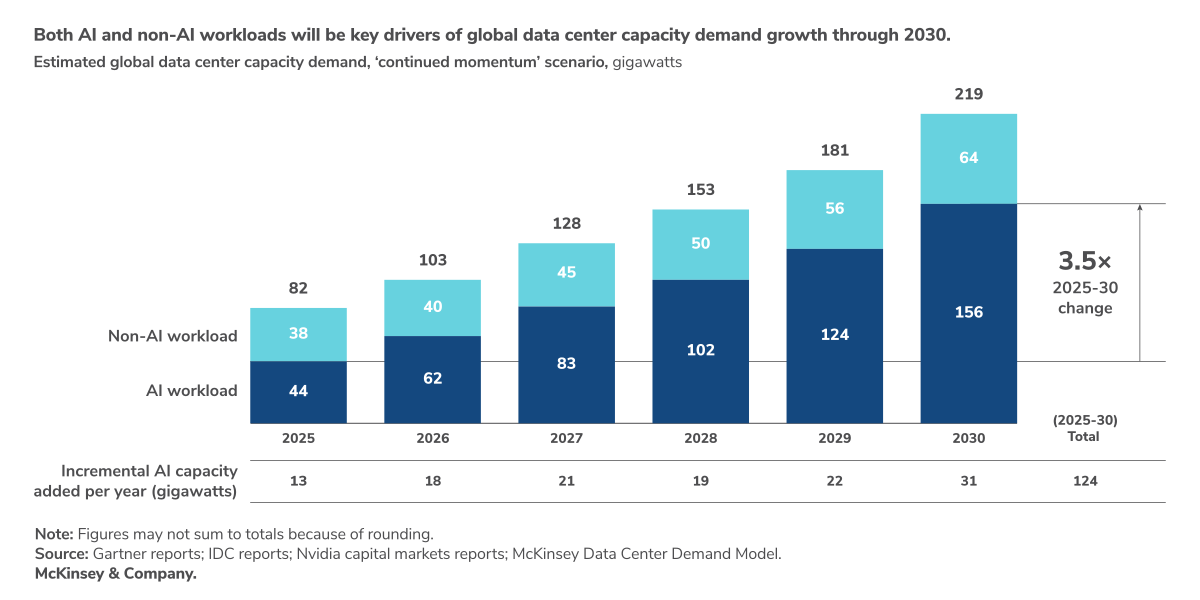
This structural transformation is driving unprecedented levels of capital investment across the digital infrastructure sector.

The Physical Aspect of Digital Assets and AI

Chart source: McKinsey & Company

The Changing Economics of Reinstatement

The economics of reinstating AI-enabled data centers have changed fundamentally. Historically, replacement cost models relied on relatively stable construction pricing, predictable procurement timelines and readily available specialist labor. That environment no longer exists. Demand for AI infrastructure has driven significant increases in the cost of construction materials, electrical equipment, transformers, specialist cooling systems and skilled engineering resources. At the same time, supply chain disruption, manufacturing constraints and longer lead times for critical equipment have made reinstatement both more expensive and more time consuming.

These changes have significant implications for insurance. Declared values can become materially outdated even within a single policy period. Traditional five-year valuation cycles and simple indexation are increasingly insufficient for highly engineered AI facilities, where construction costs, technology and engineering specifications continue to evolve rapidly. Modern insurance valuations must therefore consider not only current construction costs, but also procurement lead times, engineering complexity, utility interconnection costs and the infrastructure required to support high-density AI environments.

Increasing Asset Concentration and Loss Severity

The AI revolution has fundamentally altered the concentration of value within the data center itself. Traditional enterprise racks operating at approximately 5–10 kW typically contained hardware with replacement values of around USD 250K. By contrast, modern liquid-cooled AI racks operating at 100 kW or more can contain in excess of USD 2 million of hardware within a single rack. This dramatic increase in asset concentration significantly amplifies potential loss severity, meaning that even relatively localized physical damage can result in multimillion-dollar equipment losses before accounting for associated building services, electrical infrastructure and business interruption.

Supply chain pressures further increase reinstatement costs. Manufacturers of transformers, switchgear, cooling equipment and other critical electrical infrastructure continue to experience strong demand, while engineering, procurement and construction contractors specializing in data centers remain under capacity pressure. Developers are increasingly paying premiums to accelerate delivery, reflecting the commercial value of bringing AI capacity online as quickly as possible.

For insurers and valuation professionals, historic construction costs are no longer reliable indicators of reinstatement value. Accurate insurance valuations must reflect current market pricing, high-density design standards, engineering for liquid cooling, procurement premiums, specialist labor costs, the value of supporting utility infrastructure and the increasing concentration of high-value computing assets within modern AI data centers.

Insurance Complexity in Colocation Data Centers

The complexity of insuring modern AI data centers extends well beyond the physical asset. Many facilities operate as colocation data centers, where a single building is occupied by multiple independent customers. Ownership and insurance responsibilities are frequently fragmented. The building shell and core infrastructure, including substations, transformers, switchgear, cooling plants, backup power systems and common electrical services, may be owned and insured by the data center operator, while individual server halls, suites, cages or racks are leased to multiple tenants, each maintaining separate insurance programs for their own IT equipment, data and business interruption exposures.

A single hyperscale colocation facility can accommodate dozens, and in some cases hundreds, of separate occupiers, resulting in a complex web of property, engineering, cyber and business interruption policies that may all respond to a single physical event. Determining ownership of damaged assets, allocating responsibility for shared infrastructure and quantifying consequential losses across multiple insured parties can significantly complicate claims adjustment. For insurers, brokers and loss adjusters, understanding contractual interfaces, asset ownership boundaries and aggregation exposures is becoming as important as accurately valuing the physical infrastructure.

Valuation as a Strategic Risk Management Tool

AI data centers should no longer be viewed simply as buildings containing technology. They are critical industrial assets whose replacement cost is driven by engineering complexity, infrastructure integration and supply chain accessibility as much as by physical size.

Valuation is becoming a core component of risk management. The most effective way to mitigate underinsurance is through regular, independent insurance valuations undertaken by experienced specialists using engineering-led valuation methods. As AI infrastructure becomes more capital intensive and technically complex, relying on historic costs, internal estimates or simple indexation is unlikely to produce an accurate reinstatement value.

The cloud may appear intangible, but it is rapidly becoming one of the world’s largest drivers of physical infrastructure investment. Behind every AI model lies a network of concrete, copper, steel, transformers, cooling systems and electrical engineering that rivals many traditional industrial sectors.

Taking Action

For property owners, investors and managers, if a major loss event occurs, insurance is more than risk transfer. It is a source of contingent capital that helps fund recovery. That only works if the values supporting your program accurately reflect today’s replacement costs. To reduce the risk of underinsurance, organizations should:

  • Regularly review declared values to ensure insurance limits reflect true replacement costs.
  • Ensure valuations are undertaken using an engineering-led insurance method.
  • Reassess insurance values following significant capital investment, AI upgrades, increases in power density or major changes to mechanical and electrical infrastructure.

Kroll helps organizations navigate the opportunities and risks associated with planning, financing, securing, valuing, scaling and operating critical digital infrastructure.

Up-to-date cover is a critical component of your resilience strategy.

If your replacement cost valuation is over a year old, get in touch today.

Stay Ahead with Kroll

Fixed Asset Advisory Services

Kroll provides clients the transparency they need by identifying, managing and valuing their fixed assets.