
The Origins and Evolution of BDCs

The story of business development companies (BDCs) is deeply intertwined with America’s efforts to bolster growing businesses amid economic challenges. While the Investment Company Act of 1940 (1940 Act) spawned the mutual fund industry that tapped the expanding savings of the middle class, the resulting capital flow was directed to publicly traded issuers and benefited mostly larger companies. By the 1970s, the U.S. faced a capital crunch for emerging enterprises. Private equity and venture capital firms, burgeoning in popularity among large, sophisticated institutional investors, were hamstrung by the “small private investment company” exemption under Section 3(c)(1) of the 1940 Act. This exemption limited participation to just 100 investors, stifling the flow of funds to small, growing businesses. Policymakers recognized a “crisis in capital markets,” where traditional banks shied away from riskier loans to middle-market enterprises and venture capital was too exclusive.1

To remedy this, Congress passed the Small Business Investment Incentive Act of 1980, amending the 1940 Act to create BDCs as a new vehicle under Sections 54–65 of the 1940 Act. This bipartisan legislation, which passed with overwhelming support, aimed to “encourage the establishment of public vehicles that would invest in private companies, thereby increasing the flow of capital to small, growing businesses.”2 BDCs were envisioned as publicly traded closed-end funds, blending traits of operating and investment companies- hybrids that could provide long-term debt or equity to private or thinly traded firms, generating income and appreciation while offering retail investors liquidity and pre-IPO upside.

Cynthia Krus, Partner and Co-Chair of the Global Board at Eversheds Sutherland, explains, “Private equity sponsors long needed a vehicle that could access the public markets, operate with increased leverage and provide them with performance-based compensation. Congress then created such a vehicle, regulated through an expanded ’40 Act, that allowed private equity sponsors such flexibility, but which required that the fund invested primarily in U.S. based companies. BDCs also provide investors with access to private equity investments with the protection of the 1940 Act.”

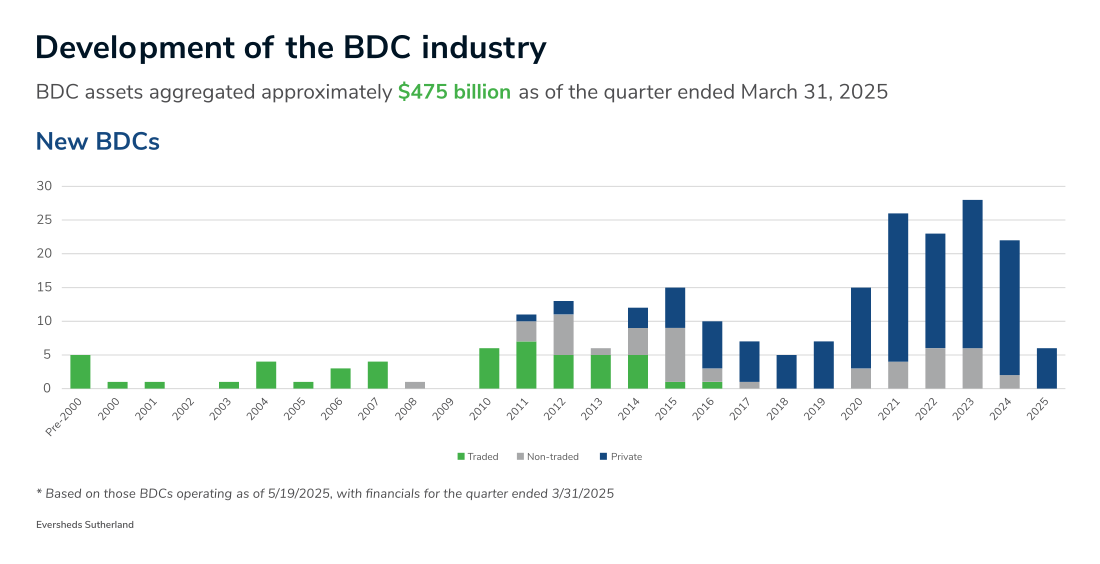
Early BDCs were mostly internally managed, focusing on income-producing models. One of the first of these was launched by Washington, D.C.-based Allied Capital, which was acquired by Ares Capital Corp. in 2009.3 The 1990s brought a pivotal enhancement: Regulated Investment Company (RIC) status under Subchapter M of the Internal Revenue Code (IRC), allowing pass-through taxation if 90% of income was distributed to shareholders annually. This tax efficiency spurred growth, but the real boom came post-2003, shifting to externally managed structures. Managers adopted the external-adviser model due to its support for management and incentive fee structures, its ability to allow sponsors to use established origination platforms, and its consolidation of staff and systems at the adviser. Apollo Investment Corp.’s 2004 IPO, raising $930 million in months, ignited a wave of offerings.4

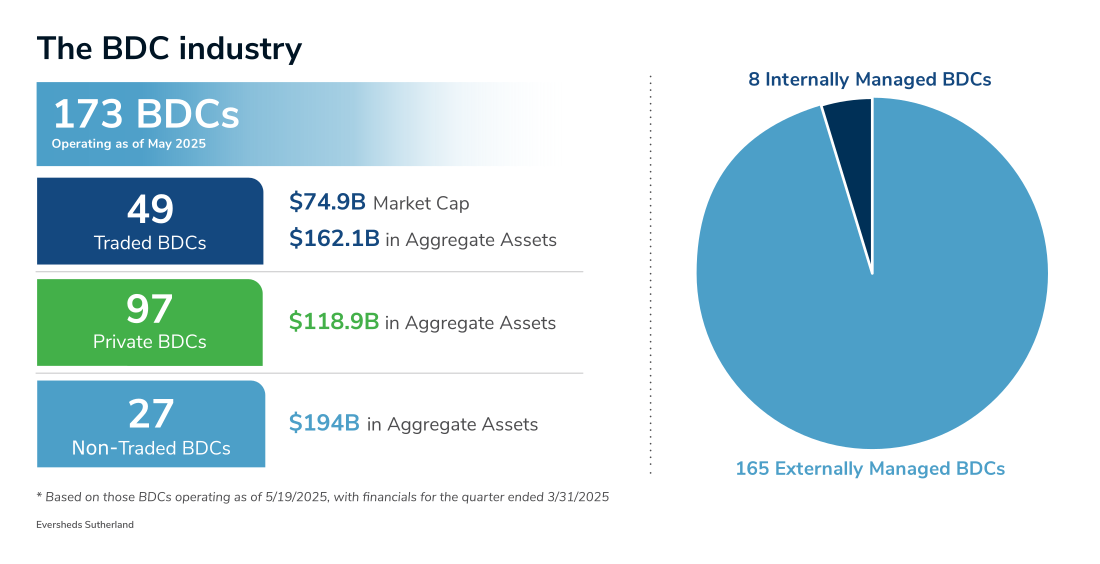
The 2010s saw another innovation: private BDCs in 2011 by firms like TPG, using capital calls akin to private funds, and perpetual-life non-traded variants post-2020 Securities and Exchange Commission (SEC) relief for multi-class shares.5 Legislative tweaks, like the 2018 Small Business Credit Availability Act (SBCAA), reduced asset coverage from 200% to 150%, increasing leverage capacity to allow BDCs to expand lending activity and potentially boosting yields. Today there are over 150 BDCs managing $400+ billion, both traded, private and non-traded forms serving diverse needs from listed liquidity to drawdown flexibility.6 Their evolution reflects a maturing alternatives landscape, filling gaps left by banks post-Dodd-Frank and further widened by recent regional bank collapses, such as Silicon Valley Bank in 2023. Krus notes, “BDCs allow the democratization of investing in private credit by granting asset managers the flexibility to offer far greater investment choices to the widest group of investors—investments that previously were the dominion of only the largest institutional investors.”

Mastering Business Development Companies | Kroll

BDC and Private Credit Market Outlook: Resilience and Growth Amid Emerging Challenges

In a persistent high-interest-rate environment, BDCs and the broader private credit sector continue to demonstrate strong performance, driven by robust investor demand. Their role is critical in filling financing gaps for middle-market companies as traditional banks pull back.

Global private credit assets reached approximately $1.5 trillion by the end of 2024, with projections estimating growth to $3.5 trillion by 2028, underscoring the asset class’s expansion and appeal.7 BDCs have been pivotal in middle-market lending in particular, with recent data showing resilience. For instance, Fitch Ratings’ analysis highlights $11.7 billion in issuance through June 2025 among key BDCs, even amid some origination slowdowns.8

Yields remain attractive at 10%–12%, attracting retail investors through non-traded perpetual vehicles, where top managers now control over 70% of assets by value, per Houlihan Lokey’s Spring 2025 BDC Monitor.9 Blue Owl Capital’s June 2025 midyear outlook positions private credit as a “preferred partner” for borrowers, anticipating a rebound in M&A despite current subdued activity.10

However, headwinds are evident, tempering the optimism. BDC Reporter’s July 2025 recap indicates the sector is up only modestly year to date, with 36 of 45 publicly traded BDCs posting positive returns and trading near highs in anticipation of potential rate cuts.11 Seeking Alpha reviews note average NAV returns around 1%, outperforming other income-focused sectors, yet Fitch and others flag risks like tariff exposure, geopolitical tensions, and muted M&A volumes leading to tighter spreads.12

KBRA’s Q1 2025 update praises BDCs for stable asset quality and strong yields but warns that many portfolios are “untested” in full economic cycles, having largely sidestepped severe downturns or extended high-rate periods since the global financial crisis.13 This vulnerability could manifest in higher non-accruals, loan defaults or liquidity strains if conditions deteriorate due to fiscal policy shifts, prolonged elevated rates or external shocks.

Overall, the narrative for 2025 points to robust growth balanced by heightened scrutiny on risks, with BDCs remaining integral to the evolution of private credit as a mainstream alternative investment. “By being long-term investments, BDCs allow investors to participate in ‘evergreen’ funds with a high level of dividend yield, and by providing permanent capital bases, BDCs allow management to work with companies without the time pressure of a typical private equity fund,” observes Krus.

Increased Competition to Win Deals

In the evolving private credit landscape of 2025, BDCs are encountering heightened competition from a surge of private credit fund managers, which is making it increasingly challenging to secure high-quality deals. With an influx of capital and new entrants into the market, driven by attractive yields and investor demand, fund managers are aggressively vying for limited deal flow, often resulting in compressed spreads, loose covenants, and innovative structures to differentiate themselves.14

This competitive pressure is particularly acute in middle-market lending, where BDCs traditionally excel, as private credit firms pitch higher leverage ratios (sometimes exceeding historical norms) to appeal to private equity sponsors seeking flexibility for add-on acquisitions or dividend recapitalizations.15 Surveys and outlooks indicate that this rivalry is prompting BDCs and other lenders to form strategic partnerships with banks or diversify into niche areas like asset-based finance to maintain origination volumes, while also leading to “covenant-lite” terms and increased use of payment-in-kind (PIK) toggles to close transactions amid a deal shortage.

For BDC operators, this environment underscores the need for robust underwriting and relationship-building to navigate the crowded field, as failure to adapt could erode margins and portfolio quality in the long term.
Benefits of Launching a BDC

Launching a BDC can offer several strategic and financial benefits for a registered investment adviser (RIA).

  • Access to Permanent Capital: BDCs allow RIAs to tap into public or private capital markets, providing a stabler and longer-term capital base than traditional private funds. This is especially valuable for strategies that require patient capital.
  • Retail Investor Participation: Unlike private funds, BDCs can be structured to allow retail investors to participate in private credit and equity investments, expanding the investor base beyond institutions and high-net-worth individuals, including foreign investors.
  • Favorable Tax Treatment: BDCs can elect to be treated as RICs, which allows them to avoid corporate-level taxation if they distribute at least 90% of their taxable income to shareholders. This pass-through structure is tax efficient for both the BDC and its investors.
  • Fee and Incentive Structures: Unlike other closed-end funds available to retail investors, externally managed BDCs can adopt management and incentive fee structures similar to those of private equity and hedge funds, including carried interest. This can be a lucrative revenue stream for the RIA managing the BDC.
  • Regulatory Flexibility: While BDCs are subject to the 1940 Act, they benefit from certain exemptions and reduced regulatory burdens compared to traditional RICs. This includes more flexibility in leverage and affiliated transactions.
  • Transparency and Market Visibility: Publicly traded BDCs are listed on major exchanges and subject to SEC reporting requirements, which can enhance transparency, brand recognition, and investor confidence
  • Diversification and Risk Management: To maintain RIC status, BDCs must meet diversification requirements, which can help mitigate portfolio risk. This structure also encourages disciplined investment practices and institutes risk management and process maturity for the firm.

How to Start a BDC: Key Steps and Structures

Launching a BDC requires substantial planning, blending corporate formation, regulatory filings, and capital strategy. BDCs are typically structured as Delaware or Maryland corporations, trusts, or limited liability corporations, and can be internally or externally managed, the latter outsourcing operations to an adviser for management and incentive fees.

Choose a Structure:

  • Traded BDCs: Listed on Nasdaq or NYSE, formed via IPO (6–8 months typical). Ideal for broad retail access, with liquidity through the public markets.
  • Private BDCs: Sold via private placement to accredited investors, using a capital call model. No exchange listing; liquidity via events like IPOs within 3–5 years.
  • Non-Traded BDCs: Continuous offerings to retail/accredited investors, with discretionary quarterly repurchases. Subject to FINRA regulation and state “blue sky” registration. Sales occur through broker-dealers and are subject to state and FINRA suitability standards.

Mastering Business Development Companies | Kroll

Formation Process:

  • Organize the Entity: File articles of incorporation and elect BDC status via Form N-54A.
  • Register Securities: Submit Form N-2 (for traded/non-traded) or Form 10 (for private) under the Securities Act of 1933 (1933 Act) and the Securities Exchange Act of 1934 (1934 Act). Include audited seed capital statements disclosing valuation policies, fees, and financing.
  • Secure Exemptive Relief: Apply for SEC orders allowing co-investments with affiliates, small business investment company leverage exclusions, or restricted stock issuance.
  • Register as an Investment Adviser: Form an RIA to manage assets and provide investment advice for externally managed BDCs. The advisory agreement between the BDC and the RIA must be approved by the BDC’s board of directors, including a majority of the independent directors.
  • Appoint a Board of Directors: Form a board of directors with a majority of independent directors, as required by the 1940 Act, to oversee BDC governance, approve investment policies and oversee compliance.
  • Compliance Setup: Appoint a chief compliance officer (CCO) and develop policies and procedures. The CCO will finalize policies and procedures for board approval, build out the testing program and establish a cadence of reporting to the board.
  • Select Service Providers: Engage an auditor, custodian, valuation firm, transfer agent, law firm, compliance consultant and administrator. Plan from the onset of these relationships to conduct ongoing oversight in accordance with Rule 38a-1 obligations.
  • Capital Raise: For traded BDCs, conduct an IPO; for private BDCs, prepare private placement memoranda; for non-traded BDCs, conduct continuous public offerings via prospectuses (registered on Form N-2 and subject to state blue-sky reviews under North American Securities Administrators Association Omnibus Guidelines). In all cases, address built-in gains tax implications for any formation transactions and warehoused portfolios acquired at launch, ensuring RIC compliance and proper disclosures in filings.
  • Manage Liquidity: Develop a share repurchase program to provide liquidity to shareholders.

Startup Costs for Launching a BDC: Key Estimates and Considerations

Estimates for starting a BDC vary widely depending on the structure (traded vs. private vs. non-traded), the scale of the launch, and factors like IPO listing for traded BDCs. However, initial costs for legal, audit, and filing fees are substantial due to the complex regulatory requirements under the 1933/1934 Acts, the 1940 Act, Sarbanes-Oxley (SOX), SEC filings and exchange governance requirements. These can easily range from $500,000 to $2 million when including registration statements, audited seed capital statements, compliance setup, and exemptive relief applications, particularly for first-time managers transitioning from private funds.

Running a BDC: Compliance and Valuation Focus

Operating a BDC demands rigorous adherence to the 1933/1934 Acts, 1940 Act, SOX, and RIC rules, with regulatory compliance and valuation as linchpins. Krus underscores, “BDCs balance the protections provided by a regulatory bulwark with the benefits offered through expansive investment opportunities. BDCs are hybrid alternative products that combine the disclosure regimen of a specialty finance company with the regulatory compliance of a mutual fund.”

Compliance Essentials:

  • Governance: Maintain a majority-independent board (non-interested under Section 2(a)(19)). Boards oversee adviser contracts (Section 15(c)) for externally managed BDCs. Annual reviews of policies under Rule 38a-1 of the 1940 Act are mandatory; BDC advisers comply via Rule 206(4)-7 of the 1940 Act.
  • Asset Rules: Seventy percent of assets should be in “qualifying” companies (eligible portfolio companies under Section 55(a)—generally U.S. non-investment firms with <$250M market cap). Monitor the 30% “non-qualifying” basket. Leverage should be capped at 150% asset coverage (post-2018 SBCAA), with board/shareholder approvals. Offer managerial assistance.
  • Affiliate Transactions: Section 57 restricts affiliate transactions; exemptive relief needed for co-investments. Board approvals require fairness findings, documented via the board meeting minutes.
  • Reporting: File 10-K/10-Qs, 8-Ks for events, and proxies. SOX demands CEO/CFO certifications (Sections 302/906) and Internal Control over Financial Reporting (ICFR) assessments (404(a)).
  • Regulatory Compliance Pyramiding: Restrictions on investing in other funds (Section 12 of the 1940 Act).
    • 90% Qualifying Income: IRC Section 851(b)(2) requires that at least 90% of a RIC’s gross income must come from qualifying sources, such as dividends, interest, and gains from securities.
    • Quarterly Diversification: IRC Section 851(b)(3) mandates diversification tests, requiring that at the end of each quarter, at least 50% of the value of the RIC’s total assets must be represented by specified assets, and no more than 25% of the value of total assets can be invested in any one issuer’s securities (with some exceptions).
    • 90% Distributions: IRC Section 852(a) requires RICs to distribute at least 90% of their investment company taxable income (and 90% of certain other income) annually to shareholders to avoid corporate-level taxation.
  • Subchapter M of the IRC outlines the tax treatment for RICs (Sections 851–855).
  • Custody: Custody via qualified banks/brokers; fidelity bond protecting against embezzlement.
  • Listing Standards: Nasdaq/NYSE standards apply for listed BDCs, including audit committee requirements.
  • SEC Regulation: The SEC routinely examines both the BDC and its adviser. Non-compliance risks SEC enforcement, fines or de-registration. Firms may outsource compliance to third-party compliance consultants but are required to retain oversight.

Valuation Nuts and Bolts:

Under ASC 820 and Rule 2a-5 (effective 2022), boards (or designees) determine fair value quarterly in good faith for investments lacking readily available market quotations, defined as reliable, unadjusted quoted prices in active markets for identical investments that the fund can access at the measurement date (aligning with Level 1 inputs under ASC 820). Rule 2a-5 establishes a principles-based framework to modernize valuation practices, applicable to RICs and BDCs, emphasizing process, testing and oversight to address increasing asset complexity and ensure consistency with U.S. GAAP. While an independent valuation service provider commonly assists the board in carrying out its responsibilities under Rule 2a-5, the board and the adviser retain ultimate responsibility for the fair value determinations.

The rule requires performing four key functions for good faith determinations, considering the fund’s specific valuation risks (e.g., conflicts of interest, market shocks, reliance on unobservable inputs or service providers):

  • Assess and manage material valuation risks periodically, with no prescribed frequency but tailored to changes in investments, strategies or events.
  • Establish and apply fair-value methodologies, selecting appropriate methods (e.g., specifying key inputs and assumptions for each asset class or holding), applying them consistently, and reviewing their appropriateness and accuracy periodically. Make changes if a different methodology is equally or more representative of fair value.
  • Test the methodologies for appropriateness and accuracy, identifying testing methods (e.g., back-testing, calibration) and minimum frequency, with flexibility based on investment type (more rigorous for Level 3 assets).
  • Oversee pricing services (if used), including processes for approval, monitoring, evaluation and initiating price challenges or overrides.

Boards retain ultimate responsibility and must oversee the valuation process, but they may designate a “valuation designee” (typically the fund’s adviser or officers for internally managed funds) to perform these functions. The designee must reasonably segregate fair value determinations from portfolio management to mitigate conflicts, specify responsible persons and their functions, and provide reports to the board: quarterly summaries of material matters (e.g., risk changes, methodology deviations, conflicts, pricing service events), annual assessments of process adequacy, back-testing and prompt notifications (no later than five business days) of significant issues like material weaknesses or NAV errors.16,17

Rule 2a-5 integrates with ASC 820’s fair-value hierarchy: Level 1 (quoted prices in active markets), Level 2 (observable inputs like similar assets or quoted prices in inactive markets), Level 3 (unobservable inputs requiring significant judgment—common for most BDC debt/equity investments). For Level 3 assets, models such as discounted cash flow, yield analysis, market multiples or option pricing are used, incorporating economic factors (e.g., interest rates, market demand), industry dynamics (e.g., competition, regulatory changes) and company-specific elements (e.g., financial milestones, management quality, covenants). Firms may engage third-party valuation firms for independence and objectivity, but boards (or designees) must oversee risks, methodologies, and testing to ensure reliability.18

Policies and procedures must address conflicts of interest, be adopted under Rule 38a-1, and include safeguards like segregation of duties. Recordkeeping under Rule 31a-4 is essential: Retain documentation for at least six years (with the first two years’ documents easily accessible) supporting valuations, risk assessments, methodologies, testing results, pricing service oversight, board reports and designated investments enabling SEC review and third-party verification. Disclose the following in filings: schedule of investments, affiliate investments, concentrations, and any material changes or risks.

In 2025, responding to rising rates, valuation scrutiny intensified (e.g., marking illiquid loans amid defaults). Errors can trigger quarterly restatements or lawsuits.

Navigating Success in BDCs

Launching and managing a BDC provides access to permanent capital and potential for attractive returns, but it also demands rigorous compliance, robust reporting and sound valuation methodologies. Amid the surge in private credit, BDCs play a critical role in middle-market financing. However, navigating an evolving regulatory environment requires constant vigilance. Long-term success depends on disciplined underwriting, transparent governance, and strategic agility especially as competition intensifies and macroeconomic conditions shift. For managers who can balance investor expectations with prudent portfolio oversight, the BDC structure remains a resilient and rewarding vehicle in today’s dynamic alternatives landscape. Krus highlights, “Unlike regulated banks, BDCs can invest up and down the capital structure depending on the needs of the market’s economic cycles. This flexibility to move up and down the capital stack is nimble, drives IRR, and meets the immediate needs of investee companies. BDCs are a true win-win."

By Colleen Corwell, Frank Galea and David Larsen

Sources:

1 Smith, A. (2014, November 20). Business development companies: the basics. Portfolio for the Future. https://caia.org/blog/2014/11/20/business-development-companies-the-basics
2 BDC primer. (2022, October 16). BDC Reporter. https://bdcreporter.com/bdc-primer/
3 Segal, J. (2014, January 28). BDCs take off as mainstream investors seek credit alternatives. Institutional Investor. https://www.institutionalinvestor.com/article/2bsubozpb0off7ahbf6yo/corner-office/bdcs-take-off-as-mainstream-investors-seek-credit-alternatives
4 Small Business Investor Alliance. (2025). Business development companies work for America. https://sbia.org/bdc/).
5 Faille, C. (2024, July 3). BDCs as a tool for the mass affluent. Private Debt Investor. https://www.privatedebtinvestor.com/bdcs-as-a-tool-for-the-mass-affluent/.
6 Small Business Investor Alliance. (2025). Business development companies work for America. https://sbia.org/bdc/
Paul, Weiss, Rifkind, Wharton & Garrison LLP. (2025). 2025 Private credit market outlook. Part I: Private credit market trends: from originations to bank partnerships and insurance. Paul Weiss. https://www.paulweiss.com/media/oejpsdor/part-i-private-credit-market-trends_-from-originations-to-bank-partnerships-and-insurance.pdf;
8 Fitch Ratings. (2025, June 30). Fitch Ratings completes peer review of eight U.S. BDCs. Fitch Ratings. https://www.fitchratings.com/research/corporate-finance/fitch-ratings-completes-peer-review-of-eight-us-bdcs-30-06-2025
9 Hedlund, A. (2025, May 13). US private credit weekly: Retail BDC money could create challenges amid tough deal backdrop. CreditSights. https://know.creditsights.com/us-private-credit-weekly-retail-bdc-money-could-create-challenges-amid-tough-deal-backdrop/
10 Blue Owl Capital. (2025, June 26). 2025 midyear outlook. https://www.blueowl.com/insights/2025-midyear-outlook
11 Raymond James. (2025). BDC weekly insight: mergers and acquisitions, public and private financings and financial advisory services. Raymond James. https://www.raymondjames.com/-/media/rj/dotcom/files/corporations-and-institutions/investment-banking/industry-insight/bdc_update.pdf
12 Diversified Income Portfolios. (2025, July 4). BDC market quick update: July 2025. Seeking Alpha. https://seekingalpha.com/mp/1337-diversified-income-streams/articles/6175618-bdc-market-quick-update-july-2025
13 The Loan Syndications and Trading Association. (2025, January 14). Private credit looking at the year ahead. LSTA. https://www.lsta.org/events/private-credit-looking-at-the-year-ahead/
14 Akin Gump Strauss Hauer & Feld LLP. (2025). Private credit: market update and 2025 outlook. Akin Gump. https://www.akingump.com/a/web/w4LCftLHQuWyDMqBmsC1a/akin_privatecredit_2025_pdfv2.pdf
15 Fishlow, O., & Schneider, E. (2025, July 10). Private credit firms pitch more leverage to win over deals. Bloomberg. https://www.bloomberg.com/news/articles/2025-07-10/private-credit-pitches-more-leverage-to-win-over-deals
16 17 CFR § 270.2a-5 - Fair value determination and readily available market quotations. (n.d.). Legal Information Institute. https://www.law.cornell.edu/cfr/text/17/270.2a-5
17 Investment Company Institute. (2024, October). An Introduction to fair valuation. https://www.ici.org/system/files/2024-10/24-ppr-intro-fair-valuation.pdf
18 Investment Company Institute. (2024, October). An Introduction to fair valuation. https://www.ici.org/system/files/2024-10/24-ppr-intro-fair-valuation.pdf


Stay Ahead with Kroll

U.S. Financial Services Compliance and Regulation

Navigate the ever-changing U.S. financial regulatory environment with confidence. Kroll provides unparalleled expertise in SEC, FINRA, NFA and CFTC regulations, helping clients mitigate risks, maintain current compliance programs and confidently overcome regulatory challenges.